How to Read a Military Grid Reference (6, 8, and 10-Figure)
June 4, 2026
A military grid reference reads from the largest area down to the smallest, in one direction: grid zone, then the 100,000 meter square, then the numbers. Inside the square the rule never changes: read right, then up. The first half of the digits is the easting (how far east), the second half is the northing (how far north). Master that one rule and you can read any reference on any map.
Cadets meet this on day one of land navigation, and it stays with you: range cards, fire support, search grids, and casualty evacuation all ride on a clean grid callout. This guide walks the format part by part, then works a real reference at 6, 8, and 10 figures.
The anatomy of a grid reference
A full Military Grid Reference System (MGRS) reference is four parts stacked left to right, each one narrowing the search. Take the Washington Monument, which sits at 18S UJ 23478 06483:
- Grid zone designator:
18Snames a 6 degree wide by 8 degree tall slice of the world. There are around 1,200 of these covering the globe. - 100,000 meter square:
UJpicks one 100 km square inside that zone. The two letters repeat in a fixed pattern, but the zone in front keeps every square unique. - Easting then northing: the digits locate a point inside the 100 km square. Always an even count of digits, split evenly: half east, half north.
The one rule: read right, then up
Picture the 100 km square divided into a 10 by 10 grid, numbered 0 to 9 along the bottom and up the side. To name a cell, you read the bottom axis first (right, the easting) and the side axis second (up, the northing). The point below lands in square 63: easting 6, northing 3.
That is the whole trick. Soldiers remember it as “in the door, then up the stairs”: you walk in (across, east) before you climb (up, north). Get the order backwards and you have swapped easting and northing, which on the ground can put you kilometers from where you meant to be.
Adding precision: 4, 6, 8, and 10 figures
The number of digits is the precision dial. Each extra pair of digits (one easting, one northing) divides the square by ten and shrinks the area you are pointing at by the same factor. Here is the Washington Monument reference held at every common length:
| Figures | Reference | Locates | Read as |
|---|---|---|---|
| 4-figure | 18S UJ 23 06 | 1 km square | E 23, N 06 |
| 6-figure | 18S UJ 234 064 | 100 m square | E 234, N 064 |
| 8-figure | 18S UJ 2347 0648 | 10 m square | E 2347, N 0648 |
| 10-figure | 18S UJ 23478 06483 | 1 m square | E 23478, N 06483 |
Notice how the digits only ever get appended, never reshuffled: 234 becomes 2347 becomes 23478. To split any reference, count the digits, cut them exactly in half, and the left half is the easting:
8 digits → split 4 / 4 → easting 2347, northing 0648
Common mistakes (and how to avoid them)
- Reading up before right. The single most common error. Easting always comes first. If you call a reference and it lands in the wrong place, swap the two halves and check again.
- Dropping the grid zone or square. A bare
234 064repeats every 100 km. Without18S UJin front, it points at hundreds of places at once. Always include the full prefix when leaving your local area. - Mismatched digit counts. Easting and northing must be the same length. An odd total means a digit was lost in transmission. Confirm before you act on it.
- Over-stating precision. A 10-figure reference claims 1 meter accuracy. If your source is a map click or a sketch, a 6 or 8-figure reference is honest; padding with zeros implies a precision you do not have.
Practice on a live map
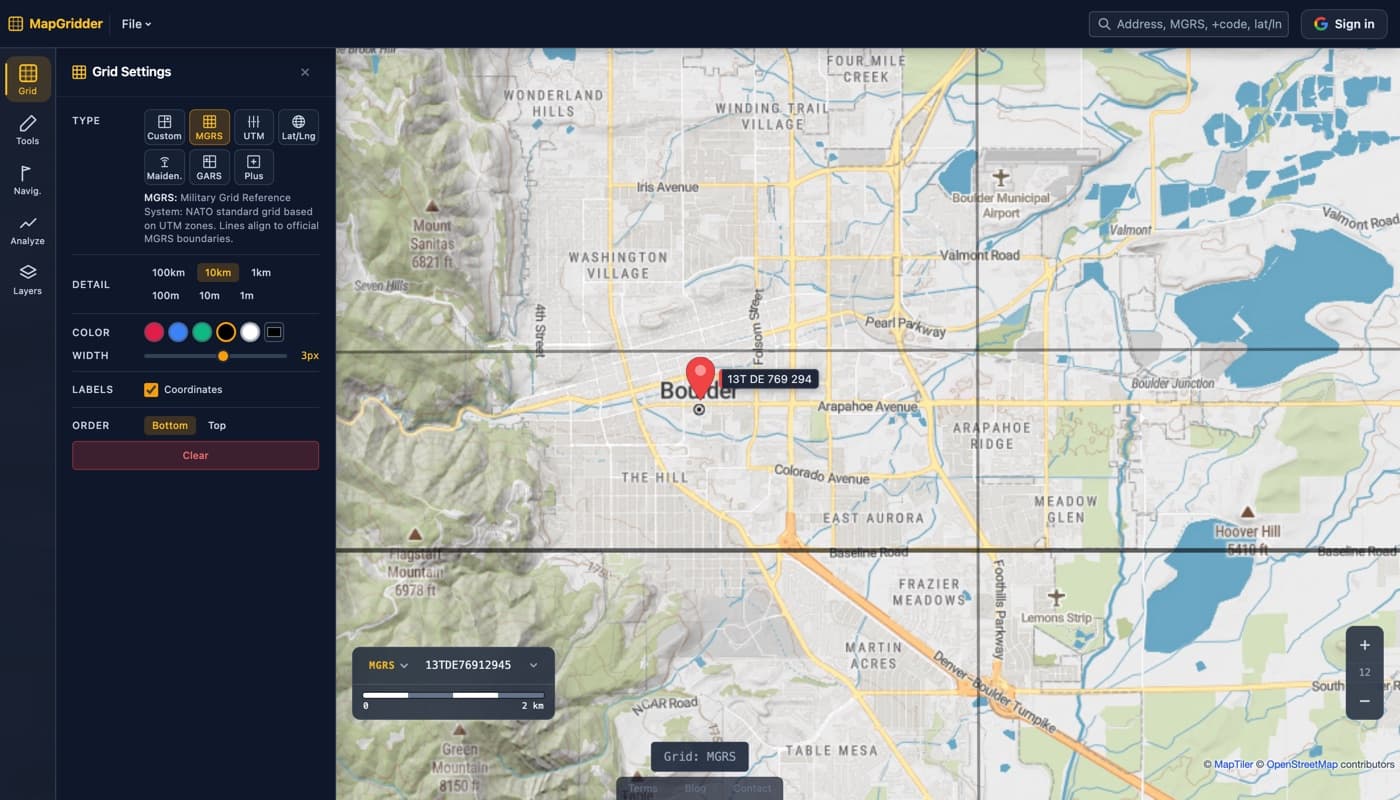
Reading references off a diagram is one thing; reading them off real terrain is the skill that sticks. Open the MGRS grid on an interactive map, zoom to ground you know, and call the squares out loud. Drop a marker, read its reference, then find it again from the numbers alone.
Frequently asked questions
How do you read a military grid reference?
Largest area to smallest: grid zone designator (e.g. 18S), then the two-letter 100,000 meter square (e.g. UJ), then the digits. Inside the square, read right then up: the first half of the digits is the easting, the second half is the northing.
What is the difference between a 6, 8, and 10-figure reference?
Precision. Six figures (3 and 3) names a 100 meter square, eight figures (4 and 4) a 10 meter square, and ten figures (5 and 5) a single 1 meter square. Every added pair of digits refines the location tenfold.
What do eastings and northings mean?
An easting is the distance east from the west edge of the 100 km square, and a northing is the distance north from its south edge, both in meters. In 18S UJ 23478 06483 the point lies 23,478 m east and 6,483 m north inside square UJ. A shorter reference drops digits from the end, so 234 064 names the 100 m square that starts 23,400 m east and 6,400 m north.
Which comes first, easting or northing?
Easting, always. Read right (east) before up (north). Splitting the digit string in half gives you the two values, with the easting on the left.
Why are there letters before the numbers?
The first part (like 18S) is the grid zone, a 6 by 8 degree slice of the globe. The two letters (like UJ) pick one 100,000 meter square inside it. Together they make the numeric easting and northing unambiguous worldwide.
How do I convert a grid reference to latitude and longitude?
Use a converter. Paste the full reference and read back decimal latitude and longitude. See the MGRS converter.
Want to see how MGRS relates to the coordinate systems underneath it? Read UTM vs MGRS vs lat/long: the difference, or open the grid on a live map.