UTM vs MGRS vs Lat/Long: The Difference
June 7, 2026 · Updated October 8, 2026
UTM and MGRS put the same point on the same metric grid, UTM as a full easting and northing in meters and MGRS as a short grid reference, while latitude and longitude measure angles in degrees.
| Lat / Long | UTM | MGRS | |
|---|---|---|---|
| Measures | Angles (degrees) | Meters E / N | Meters E / N |
| Looks like | 38.8895, -77.0353 | 18N 323478 4306483 | 18S UJ 23478 06483 |
| Covers the globe as | One continuous grid | 60 zones, 6° wide | Zones + 100 km squares |
| Easy to call out | Hard (long decimals) | Medium | Easy (short reference) |
| Measure distance directly | No (degrees vary) | Yes (meters) | Yes (meters) |
| Best for | Web maps, global data | Surveying, GIS analysis | Ground navigation, callouts |
Latitude/longitude, UTM, and MGRS are three ways to write the same point. Lat/long gives an angle on the globe in degrees. UTM flattens the world into zones and measures meters east and north. MGRS takes those UTM meters and packs them into a short grid reference. Same location, different handwriting.
The Washington Monument makes the point. Here it is, one spot, written all three ways:
Latitude and longitude: angles on a sphere
Latitude and longitude are the oldest of the three. They treat the Earth as a globe and give two angles: latitude is degrees north or south of the equator, longitude is degrees east or west of the prime meridian. The Washington Monument is 38.8895° N, 77.0353° W, usually written 38.8895, -77.0353 with a minus sign for west.
The strength is universality: one seamless system for the whole planet, which is why it is the native language of web maps and global datasets. The weakness is that a degree is not a fixed distance (a degree of longitude shrinks toward the poles), so you cannot eyeball distance from the numbers, and long decimals are clumsy to read over a radio.
UTM: meters on a flattened world
Universal Transverse Mercator (UTM) fixes the distance problem by giving up on one seamless grid. It slices the world into 60 zones, each 6 degrees of longitude wide, and flattens each zone on its own. Inside a zone, position is plain meters: an easting (meters east of the zone's center line) and a northing (meters north of the equator).
So the Washington Monument is 18N 323478 4306483: zone 18, northern hemisphere, 323,478 meters east and 4,306,483 meters north. The catch is the numbers are long, and they reset at every zone boundary, so data crossing a zone needs care.
Tip: because UTM is in meters, plain subtraction gives you distance. The White House is at 18N 323394 4307396:
323478 - 323394 = 84 m east-west
4307396 - 4306483 = 913 m north-south
So the White House sits 913 meters north and 84 meters west of the Monument: about 0.9 km apart, no formula needed.
MGRS: UTM, packed into a grid reference
The Military Grid Reference System (MGRS) keeps UTM's meters but trims the fat. Those long easting and northing values share leading digits with everything else in the area, so MGRS replaces them with a two-letter 100,000 meter square and keeps only the digits that actually change. Watch the UTM coordinate collapse:
The dimmed leading digits become the letters UJ; the band letter S replaces the hemisphere. The meaningful digits carry over unchanged.
The result, 18S UJ 23478 06483, is short enough to read aloud cleanly and still pins a 1 meter square. That is exactly why ground forces, search and rescue, and orienteers favor it: it is fast to say, hard to mishear, and you can shorten it to the precision you need (see how to read a 6, 8, or 10-figure reference).
Which one should you use?
- Lat/long when you are working with web maps, sharing a pin, or handling data that spans the globe or many UTM zones.
- UTM when you are surveying or doing measurement-heavy GIS work inside one region and want plain meters to compute with.
- MGRS when people have to say positions out loud or write them down fast: land navigation, fire support, search grids, field exercises.
Because they describe the same point, you can convert freely between them. Paste any of the three into a converter and read back the others.
Where does USNG fit?
USNG, the United States National Grid, was adopted as a federal standard in 2001 so that civilian responders, utilities and the military could read the same reference off the same map. It is MGRS: the same zones, the same 100,000 meter square letters, the same truncated easting and northing digits. Write the Washington Monument in either and you get the same string, 18S UJ 23478 06483.
Two differences matter in practice. USNG is specified on the NAD83 datum rather than WGS84, which shifts a position by one to two meters in the continental United States, well inside the precision anyone reads aloud. And USNG allows a reference to be shortened for local work: crews already inside one 100 km square drop the grid zone and read UJ 23478 06483, or drop the letters as well and read 23478 06483.
If you are looking for a USNG grid, an MGRS overlay is the same grid.
Three landmarks, all three ways
| Place | Lat / Long | UTM | MGRS |
|---|---|---|---|
| Washington Monument | 38.8895, -77.0353 | 18N 323478 4306483 | 18S UJ 23478 06483 |
| Eiffel Tower | 48.8584, 2.2945 | 31N 448252 5411954 | 31U DQ 48252 11954 |
| Sydney Opera House | -33.8568, 151.2153 | 56S 334900 6252288 | 56H LH 34900 52288 |
Overlay all three on a live map
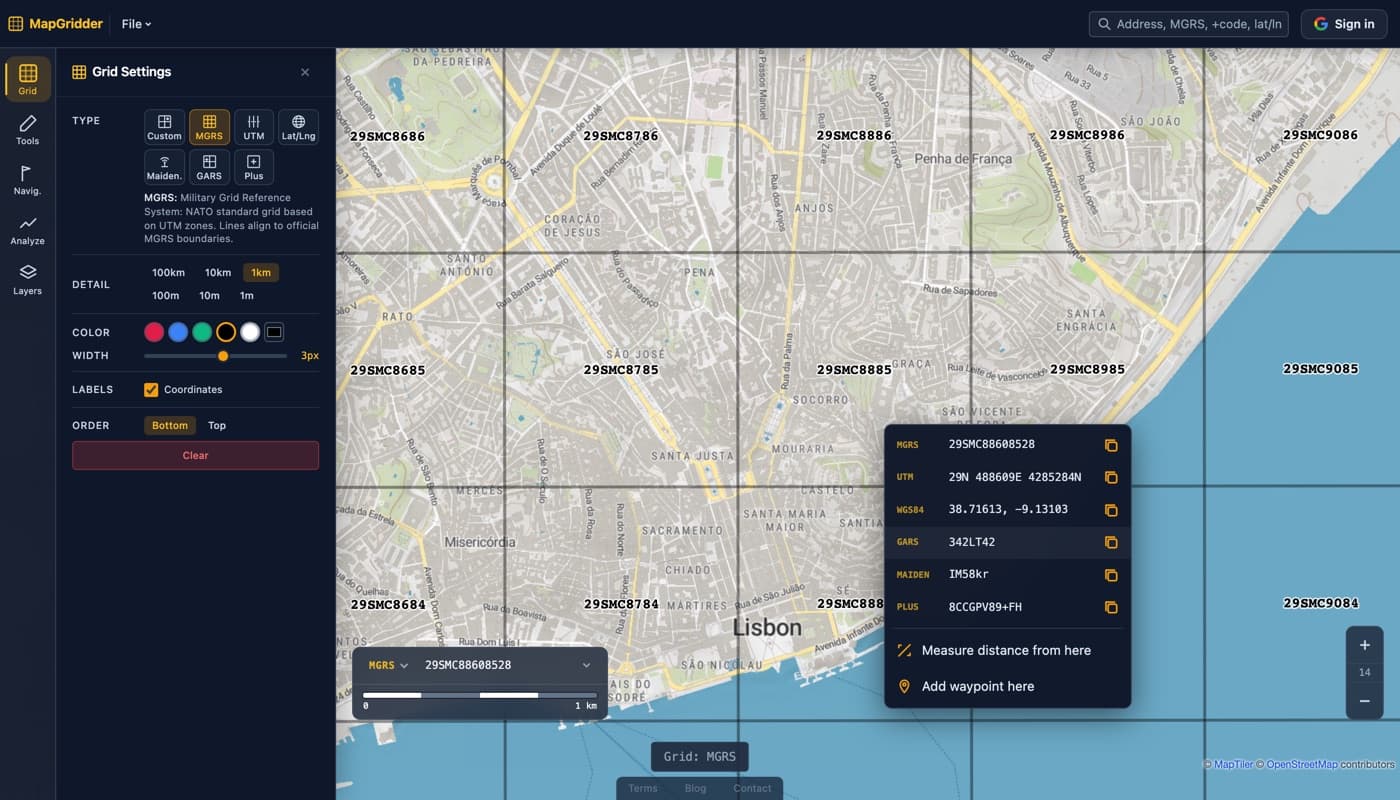
The fastest way to understand the three systems is to look at them. MapGridder draws each one as a live grid overlay: open the Grid panel and the Type selector offers all three, side by side with a custom metric grid.
- MGRS grid: grid zone boundaries, 100 km letter squares, and metric sub-grids with the reference labels written in each cell.
- UTM grid: the plain version of the same projection. 6° zone meridians, the equator, and easting/northing lines carrying the two-digit grid numbers (…34 35 36…) you know from paper military maps, with one full easting/northing reference in the corner.
- Lat/Long graticule: lines of constant latitude and longitude that step from 10° whole degrees down to single seconds as you zoom, labeled in degrees-minutes-seconds like 34°55′58″E.
Every mode adapts its detail to the zoom level, and you can pin the detail you want (say, a fixed 1 km UTM grid or a 1′ graticule). Right-click any point on the map to read it back in all three formats at once; that is the whole comparison above, live.
Frequently asked questions
What is the difference between MGRS, UTM, and lat/long?
Lat/long gives an angle in degrees, UTM gives meters east and north within a zone, and MGRS writes those UTM meters as a short alphanumeric grid reference. They describe the same point in different units and formats.
Is MGRS the same as UTM?
MGRS is built on UTM and shares its projection and zones, but it relabels the position: a two-letter 100,000 meter square replaces the leading digits, leaving a shorter reference that is easier to read aloud.
Why not just use latitude and longitude for everything?
Degrees are not a fixed distance and long decimals are awkward to communicate. UTM and MGRS use meters, so you can measure distance directly and call out a position quickly with less chance of error.
Is USNG the same as MGRS?
For practical purposes yes. USNG uses the same zones, the same 100,000 meter square letters and the same truncated digits, so a reference for a given point is written identically in both. USNG is specified on the NAD83 datum rather than WGS84, a shift of one to two meters in the continental United States, and it allows a reference to be shortened for local work.
Can I use an MGRS grid overlay for USNG?
Yes. Across the continental United States an MGRS overlay reads as USNG, because both systems label the same squares with the same letters and digits. Shortened readings also work in search, so a reference passed over the radio without its grid zone still resolves near the area you are looking at.
Can I overlay MGRS, UTM, and lat/long grids on a live map?
Yes. MapGridder draws all three as live overlays: MGRS with its zone and square labels, a plain UTM grid with two-digit grid-line numbers, and a lat/long graticule labeled in degrees, minutes, and seconds. Each adapts its detail to the zoom level. It runs in the browser and is free for personal use.
How do I convert between them?
Use a converter: paste lat/long and get MGRS, or paste an MGRS reference and read back lat/long and UTM. Try the lat/long to MGRS converter; it works in both directions.
Ready to read a grid reference for yourself? See how to read a military grid reference, or open the grid on a live map.